


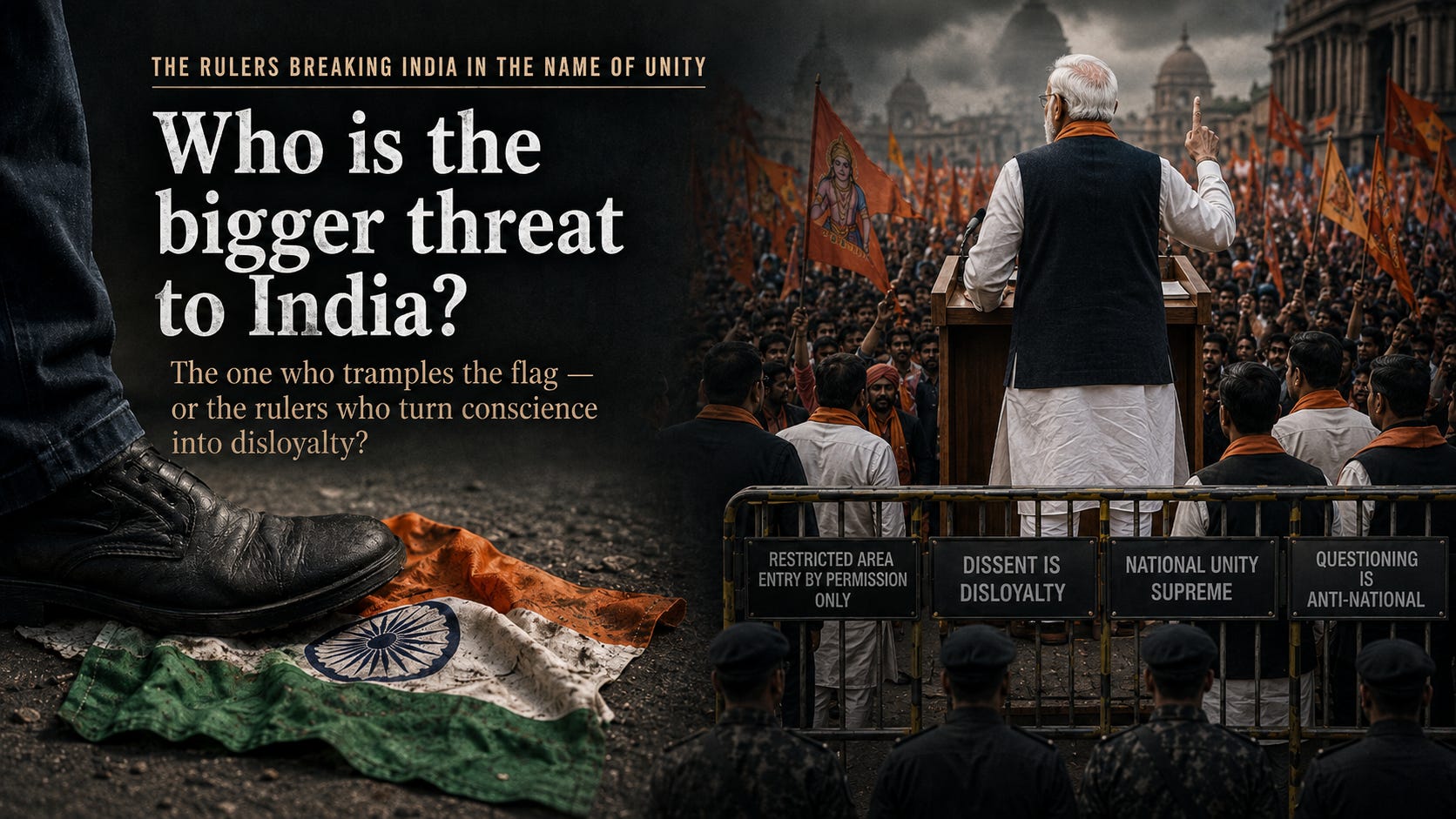
PanthSeva editorial illustration. It is not a photograph of the New York protest.
Plain-English renderings are mine. The Roman line under each Gurmukhi line is only a reading aid. It is not the translation. The English sentence gives the plain meaning.
On a New York pavement, one man insulted the Indian flag. In India, a government with Parliament, ministries and public institutions behind it is narrowing who counts as fully Indian. The first act was ugly. The second is more dangerous, because it can turn Hindutva into law, policy and the daily terms of citizenship.
On 29 August 2026, outside Madison Square Garden in New York, a protester walked on the Indian flag. Another flag was torn. I watched the footage and understood the anger. The act was deliberate. It was meant to insult India, and it did. Union minister Kiren Rijiju responded: “Do not insult our flag and my country. It will cost you dearly.” [1]
Had the same public trampling taken place in India, it could have led to prosecution and, on conviction, imprisonment for up to three years. In New York, political flag desecration is generally protected expression. That does not make the act honourable. It means only that, by itself, it is not a crime there. [1]
Yet the longer I looked at the image, the less willing I was to stop with that act.
The man on the pavement could offend India, but he could not decide what India is. He could not write its citizenship law, direct its ministries, shape its public institutions or tell whole communities that they belong only after accepting a Hindu account of the nation. Those powers belong to government.
Once I put the two acts beside each other, my answer was clear. The BJP-led Union government’s Hindutva project is a greater danger to India than the man who trampled its flag. His insult lasted a few seconds. Government power can change the terms on which people live together for years.
But anger alone cannot be the measure. For that, I return to Bhagat Kabir Ji.
ਅਵਲਿ ਅਲਹ ਨੂਰੁ ਉਪਾਇਆ ਕੁਦਰਤਿ ਕੇ ਸਭ ਬੰਦੇ ॥
ਏਕ ਨੂਰ ਤੇ ਸਭੁ ਜਗੁ ਉਪਜਿਆ ਕਉਨ ਭਲੇ ਕੋ ਮੰਦੇ ॥੧॥
ਲੋਗਾ ਭਰਮਿ ਨ ਭੂਲਹੁ ਭਾਈ ॥
ਖਾਲਿਕੁ ਖਲਕ ਖਲਕ ਮਹਿ ਖਾਲਿਕੁ ਪੂਰਿ ਰਹਿਓ ਸ੍ਰਬ ਠਾਂਈ ॥੧॥ ਰਹਾਉ ॥
aval alah noor upaaiaa kudrat ke sabh bande.
ek noor te sabh jag upjiaa kaun bhale ko mande.
logaa bharam na bhoolahu bhaaee.
khaalik khalak khalak meh khaalik poor rahio srab thaaee. Rahao.
First, Allah brought forth the Light; through Kudrat, all beings came to be. From the One Light the whole world arose; who then is good and who is bad? People, brothers, do not lose yourselves in delusion. The Creator is within creation and creation within the Creator, pervading every place.
Bibhaas Prabhaati, Bani Bhagat Kabir Ji Ki, Shabad 3, Pannas 1349 and 1350. The opening verse is on Panna 1349; the Rahao lines are on Panna 1350.
Bhagat Kabir Ji begins before India, before the flag and before any majority acquired the power to call itself the nation. Every person has already arisen from the One Light. The state does not give that worth. It meets it and is required to protect it.
A ruler therefore does more than offend when he places one community above another. He damages the equal human belonging that allows a country of many faiths and peoples to remain one country.
That is why the man in New York and the government in Delhi cannot be judged by the same scale. One insulted a symbol. The other possesses the power to narrow the country the symbol is meant to represent.
What the rulers say
The danger is not hidden inside a secret document. The BJP and RSS have described their idea of India in public.
The BJP says it is committed to “One Nation, One People and One Culture”. The RSS says that India belongs to Hindus and that the national identity of its people is essentially Hindu. Its own explanation allows Muslims and Christians to take part if they accept its account of common ancestry, culture and motherland. [2]
In November 2025, Mohan Bhagwat put the condition more plainly. “Only Hindus are allowed” in the Sangh, he said. Muslims and Christians may come to a shakha, he said, but “keep your separateness out”. They enter as children of Bharat Mata and as part of Hindu society. [2]
The usual reply is that Hindu is being used as a broad civilisational word, not as a narrow religious label. That reply does not solve the problem. It states it.
A Sikh may keep the gurdwara, a Muslim the mosque and a Christian the church, but the majority still claims the right to name their deeper national identity. Difference is permitted after it has been placed inside a Hindu whole.
That is not equal belonging. It is assimilation described as inclusion.
The connection with the Union government is also public. At the RSS centenary in October 2025, Narendra Modi spoke as Prime Minister and “as a swayamsevak”. He said the government was acting upon challenges identified by the RSS and praised the organisation for producing a concrete roadmap for the country. [2]
The RSS and BJP are not the same legal body, but the relationship is no invention of their critics. The Prime Minister himself has told the country where he stands and which organisation’s programme he regards as part of India’s future.
This is why I use the word Hindutva. I am not using it as an insult to Hindu people. It names a political idea which the BJP claims as cultural nationalism and which the RSS describes through Hindu Rashtra. Many Hindus reject that idea. Many BJP voters choose the party for other reasons. The issue here is the project carried through government power, not the faith or character of every Hindu citizen.
The distinction matters because Sikhs know what absorption looks like when it arrives with praise. The Gurus are honoured. Langar is admired. Sikh courage is celebrated. Then Sikhi is placed inside a Hindu civilisation and the Sikh is told that this is the deeper truth of who he is.
Praise does not answer the question of authority. Who has the right to name the Sikh: the Guru, or the political majority?
When those words acquire power
The dispute over Vande Mataram shows how quickly a national idea can become a test of conscience.
I examined the full song, its history and the 2026 law in Should a Sikh Sing Vande Mataram?. Here the song matters because it shows what happens when one tradition’s devotion is turned into a test for everyone else.
The complete official version identifies the Mother with Saraswati, Lakshmi and Durga. The Prime Minister has called the song a mantra and said it embodies devotion and spiritual dedication to Maa Bharati. Citizens who receive those words through their own faith are free to sing them. A Sikh is equally free not to. [3]
The law punishes someone who deliberately prevents the singing or disturbs the gathering. It does not make respectful silence a crime. Yet when the Congress Working Committee decided in August 2026 to continue singing only the first two stanzas, Home Minister Amit Shah called the decision anti-national and an open defiance of the law made by Parliament. He wrote in Hindi; the English is a translation. [3]
A Sikh who stands quietly has not insulted India. He has refused to use another tradition’s worship as proof of loyalty. When the government turns that boundary of conscience into suspicion, it is no longer merely honouring a song. It is telling the citizen that full belonging requires a religious act.
The same habit appeared during the 2024 general election. At a campaign rally, Narendra Modi warned that wealth would be given to “those who have more children” and to “infiltrators”, after invoking a claim about Muslims having the first right over national resources. He later said that he had not spoken in Hindu-Muslim terms. The later denial cannot erase the words the country had already heard. [4]
This matters because the speaker was not a man at the edge of politics. He was the Prime Minister seeking another term. A government teaches through the people it praises, the fears it repeats and the citizens it places under suspicion.
The same religious distinction is also written into citizenship law.
The Citizenship (Amendment) Act gives a special route to citizenship to Hindu, Sikh, Buddhist, Jain, Parsi and Christian migrants from Afghanistan, Bangladesh and Pakistan who entered India by the end of 2014 and meet the Act’s other conditions. Muslims are excluded from that route. [5]
The government says the Act offers relief to persecuted minorities from neighbouring Islamic republics and does not remove the citizenship of any Indian Muslim. That explains the case made for the law, but it does not remove the religious line Parliament chose to draw. The Act did not create a general test of persecution and apply it to everyone. Ahmadi, Shia and other persecuted Muslim communities from the same countries receive no equivalent route.
As a Sikh, I am named on the favoured side. That does not free me from asking what has been done to the person left outside. Sikh advantage cannot make a religious preference equal. Bhagat Kabir Ji’s One Light is not divided because Parliament has placed my community in the preferred list.
The same political mood becomes more severe when accusation begins to look like punishment.
In several BJP-governed states, authorities demolished homes and shops connected with people accused after crimes, protests or communal incidents. Officials said the structures were unlawful. Families and rights groups said bulldozers were being used to punish people, often Muslims, before guilt had been proved. [6]
In November 2024, the Supreme Court said the executive could not decide guilt and punish an accused person by demolishing a home. It rejected collective punishment and required notice and due process. An unlawful structure may still be removed, but the state must act through law rather than use an accusation as its verdict. [6]
The Union government did not issue every demolition order. But these actions took place under BJP governments and within a political culture in which strength is repeatedly shown through the public humiliation of people already treated as suspect.
A house is not an abstract planning violation to the family standing outside it. It is where children sleep, medicines are kept and an elderly parent expects to spend the night. When the state arrives with a bulldozer before a court has established guilt, the message travels far beyond that building.
This is what makes the government more dangerous than the protester in New York. The protester’s reach ended with his own act. The government’s ideas can travel through speeches, Parliament, ministries, state administrations and the conduct of public authorities.
An election does not remove this danger. It gives a government authority to govern for a term. It does not make a party the owner of India or give it ownership of anyone’s conscience. Roads, welfare and public services are duties of government. They are not payment for the right to define the recipient’s religion or national identity.
The Guru’s test of rule
Guru Nanak Sahib Ji gives a severe description of rule when Dharam has been driven out of public life:
ਸਲੋਕੁ ਮਃ ੧ ॥
ਕਲਿ ਕਾਤੀ ਰਾਜੇ ਕਾਸਾਈ ਧਰਮੁ ਪੰਖ ਕਰਿ ਉਡਰਿਆ ॥
ਕੂੜੁ ਅਮਾਵਸ ਸਚੁ ਚੰਦ੍ਰਮਾ ਦੀਸੈ ਨਾਹੀ ਕਹ ਚੜਿਆ ॥
salok mahallaa 1.
kal kaatee raaje kaasaaee dharam pankh kar uddariaa.
koorr amaavas sach chandramaa deesai naahee kah charriaa.
This dark age is the knife; the rulers are butchers; Dharam has taken wing and flown. Falsehood is the moonless night; the moon of Truth is nowhere seen rising.
Majh Ki Vaar, Salok Mahalla 1, Panna 145, Guru Nanak Sahib Ji. These are the opening two lines of a six-line Salok.
I do not use this Salok as a name to throw at every politician I oppose. Guru Nanak Sahib Ji gives something more serious than an insult. The Shabad gives a test.
What happens to the people under those who rule? Are they protected equally, or divided into those who own the nation and those who must keep proving they belong? Is conscience protected, or is majority devotion turned into a loyalty test? Does law restrain power, or does punishment arrive first and legal process later?
The present government fails that test where its Hindutva idea enters public power.
By this point the pattern is no longer difficult to see. The movement that calls India essentially Hindu now speaks through a Prime Minister who also names himself an RSS swayamsevak. Its devotional language has been used to question Sikh loyalty. Its campaign rhetoric has placed Muslims beside infiltrators. Its citizenship law prefers six religions and leaves Muslims outside that route. In BJP-governed states, demolitions were used in circumstances serious enough for the Supreme Court to remind the executive that it is not judge and punisher.
Each act has its own setting, but they point in the same direction. India is being defined from the majority outward. Others may remain, but on terms they did not choose.
That is dangerous because India cannot remain a shared country if one community is treated as the owner of the nation and everyone else must belong on its terms.
I return, then, to the image.
The man in New York did something contemptible. He put the Indian flag beneath his foot. His act deserved condemnation, and he alone should answer for it.
But the flag is not the whole country. India is also the Sikh who will not sing devotion to Durga, the Muslim excluded from a religious route to citizenship, the family watching a bulldozer approach before guilt has been proved, and the Hindu who refuses to let his own faith become the state’s name for everyone.
The protester could insult those people’s flag. The government can alter their place in the country.
That is why the Hindutva government is the greater danger in the comparison before us. The man’s power ended with his own act. The government exercises power through law, administration, public institutions and national office.
Bhagat Kabir Ji’s question remains. If the whole world arose from the One Light, by what right does any majority make itself the national owner and reduce others to citizens on conditions it sets?
The boot on the flag was ugly. The deeper insult is to use the flag while weakening the equal standing of the people it is meant to represent.
The man in New York insulted India for a moment.
The rulers are breaking India in the name of unity.
Verification and sources
The Gurmukhi, Panna references, Bani headings, attributions and quotation boundaries were checked against SearchGurbani and SriGranth. Professor Sahib Singh Ji’s Sri Guru Granth Sahib Darpan was consulted additionally for contextual sense. The English passages are learning renderings. They do not replace the Gurmukhi or the need to read the complete Shabad and Salok.
Cross-check: Every Gurmukhi line, Panna reference and attribution in this article can be checked at SearchGurbani and SriGranth.
Correction note: If a mismatch is found in the Gurmukhi, Panna reference, Bani heading, attribution, Roman reading line, English sense, legal description or source account, PanthSeva will correct it publicly, calmly and with a dated correction note.
1. The New York protest and the flag: Moneycontrol, 30 August 2026, reporting the protest outside Madison Square Garden on 29 August while Mohan Bhagwat spoke inside. Section 2 of the Prevention of Insults to National Honour Act 1971 includes public trampling of the Indian National Flag and permits imprisonment for up to three years, a fine, or both. The American constitutional principle comes from Texas v Johnson, 491 U.S. 397 (1989) and United States v Eichman, 496 U.S. 310 (1990). Those cases concerned the American flag. Separate offences involving violence, trespass, theft or damage to another person’s property remain punishable. Union minister Kiren Rijiju’s response, including the words quoted in the article, was reported by The Economic Times, 31 August 2026.
2. The declared BJP and RSS idea of India: BJP, “Cultural Nationalism”, including “One Nation, One People and One Culture”; RSS, “Basic FAQ on RSS”, which says that the country belongs to Hindus and that national identity is essentially Hindu; Mohan Bhagwat’s November 2025 remarks reported by The Indian Express; and the Prime Minister’s RSS centenary address of 1 October 2025.
3. Vande Mataram: The full Shabad-led, historical and legal examination is in PanthSeva’s Should a Sikh Sing Vande Mataram?. The summary here is supported by the Ministry of Home Affairs order of 28 January 2026, the Prime Minister’s address of 7 November 2025, the Prevention of Insults to National Honour (Amendment) Act 2026, and Amit Shah’s post of 20 August 2026, in Hindi, reported by The Indian Express. The amended section punishes intentional prevention of singing or disturbance of an assembly. It does not create an offence of respectful silence.
4. The 2024 election speech: Reuters, 22 April 2024 and Reuters, 14 May 2024, reporting the Prime Minister’s words at the Banswara rally and his later denial that he had spoken in Hindu-Muslim terms.
5. Citizenship: Citizenship (Amendment) Act 2019 and Citizenship (Amendment) Rules 2024, official Government of India texts.
6. Demolition as punishment: In Re: Directions in the Matter of Demolition of Structures, Supreme Court of India, 13 November 2024, 2024 INSC 866; and Reuters, 13 November 2024. The Court held that the executive cannot punish an accused person by demolishing property, rejected collective punishment and issued nationwide due-process directions.
Current legal and political claims were checked to 4 September 2026.
The statutes, court judgements, political documents and news reports identify public words and actions. They do not govern the doctrinal judgement.
That judgement remains answerable to Shabad Guru Granth Sahib Ji.
Strong disagreement is welcome. Contempt is not.
Bhul chuk maaf karni Ji.
Gurjit Singh Sandhu
PanthSeva
London