


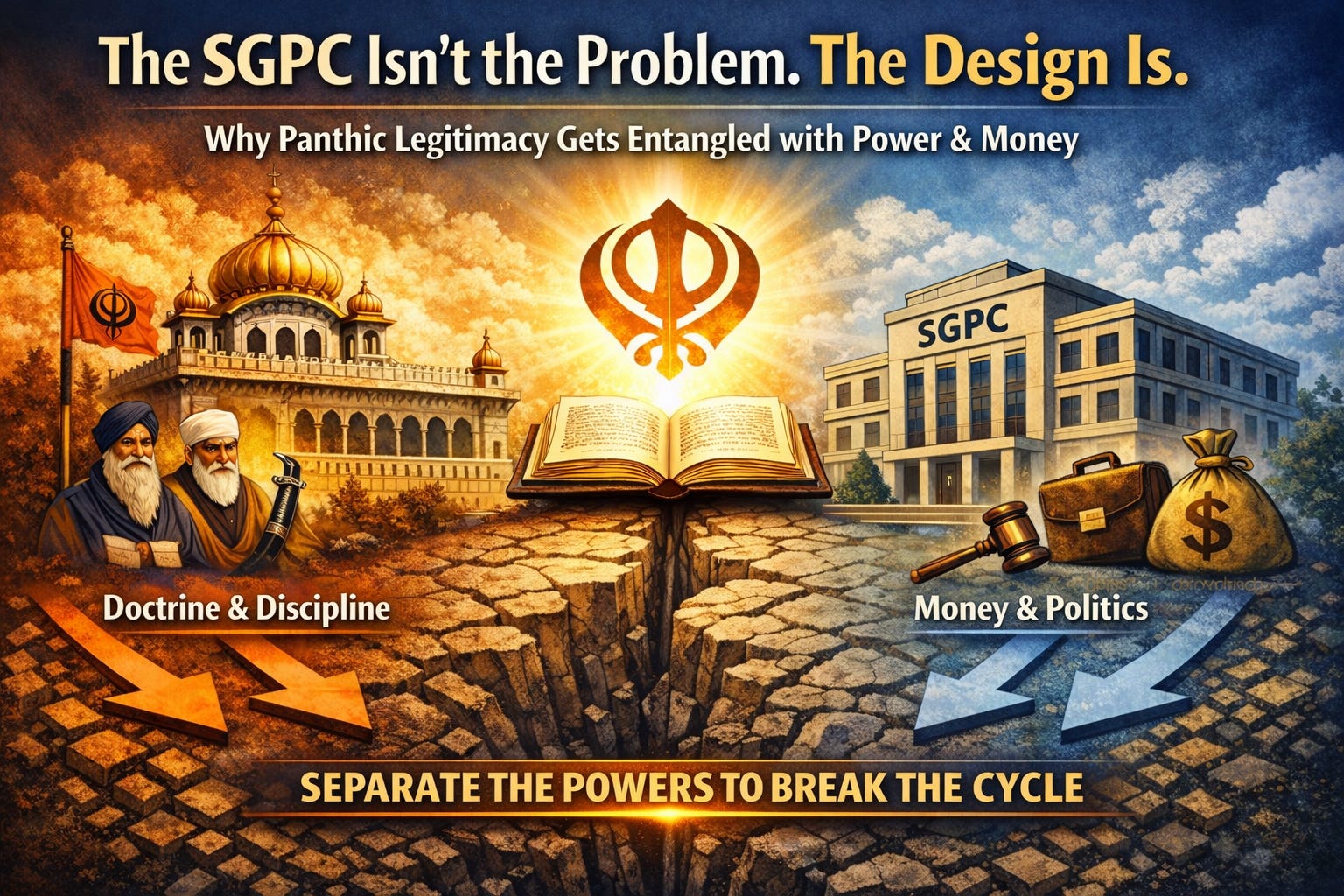
This is not primarily about personalities or factions. It is about a governance design that fuses trusteeship (money, property, jobs) with Panthic sovereignty (doctrine, discipline, legitimacy) — and that fusion makes crisis inevitable. This piece proposes a separation-of-powers model to break the cycle.
Another 72-hour ultimatum. Another crisis. Same constitutional problem.
Over the last few days, Sikhs have watched a familiar pattern repeat. A senior Panthic figure goes public with serious allegations. The SGPC responds with a "submit proof within 72 hours" notice. A counter-ultimatum follows. Political actors rush in to weaponise the moment. And the Sangat is left with anger, fatigue, and division — because nobody trusts the process and everyone doubts the motives.
Many people are asking: Who has the right to speak? Who has the right to act? Who has the right to discipline? Who has the right to reform?
Those questions matter — but before we argue about "who", we have to be honest about "why this keeps happening."
This is not only a clash of personalities, factions, or family-based politics. It is a structural governance failure: a constitutional design flaw that makes crisis predictable.
The flaw in one sentence
We have allowed a trusteeship system — meant to manage property, budgets, staff, and daily operations — to sit so close to Panthic sovereignty — doctrine, discipline, identity boundaries, Panth-significant authority — that money and office can pressure the Takht. And once that happens, every trusteeship dispute turns into a Panthic legitimacy war.
When trusteeship and sovereignty are fused, corruption allegations become spiritual warfare; committee notices start sounding like "Panthic justice"; press conferences get treated as "Panth-binding announcements"; and the Sangat gets pushed into camps instead of truth.
That is the constitutional trap we must escape.
Why I say "Sikhi" — and why language matters
I use "Sikhi" deliberately because this is not just an organisational or managerial problem. Sikhi is a lived path under Sri Guru Granth Sahib Ji as Shabad-Guru — where truth, discipline, seva, and collective responsibility must be carried with dignity.
That matters because the real question is not "which committee is supreme?" The real question is: how do we prevent any committee, party, or state structure from claiming spiritual sovereignty through positional power?
The uncomfortable truth: trusteeship is a capture target
Whatever your view of today's allegations, one constitutional fact is undeniable: SGPC trusteeship controls large flows of money, land, jobs, contracts, institutions, and prestige. That makes it a permanent capture target.
To understand why "capture" is not a theory but a predictable risk, look at the scale. SGPC's publicly announced annual budgets in recent years:
₹1,138.14 crore (FY 2023–24) — approximately $125.1m
₹1,260.97 crore (FY 2024–25) — approximately $138.6m
₹1,386.47 crore (FY 2025–26) — approximately $152.4m
(USD conversions at RBI/FBIL reference rate around ₹90.95 per $1.)
Whether any specific allegation is true is not the point of quoting those figures. The constitutional point is simpler: big money, scarce property, and appointments create a predictable corruption-risk triangle across procurement and contracts, payroll and appointments, and land and building decisions.
A governance design that quietly assumes "capture won't happen" is already an unserious design. A mature design assumes capture attempts will happen — and builds locks so wrongdoing becomes harder to do and easier to detect.
A discipline we keep missing: scope clarity
A second reason crises spiral is that everything gets treated as automatically Panth-binding the moment it becomes dramatic or public. Sikhi needs scope discipline.
Think of it this way. A press conference — even by a respected Panthic figure — may be morally serious, but it is not automatically Panth-binding. An SGPC notice demanding written proof is a trusteeship-domain act: a revisable administrative step. It is not a Gurmatta. A call for Sarbat Khalsa is, at most, guidance to convene — and if any body tries to issue binding decisions, the legitimacy burden becomes extremely high: representation, record, reasons, dissent handling, appeal, and review must all be demonstrable, especially for a global Panth across many jurisdictions.
When scope is not kept clear, we get scope inflation: guidance gets marketed as binding, and trusteeship levers get used to manufacture or crush sovereignty claims. That is how trust collapses.
The reform we need is not cosmetic. It is separation of powers.
If we want this cycle to stop repeating for another generation, the answer is not louder statements. It is constitutional engineering.
The core reform principle is this: make it impossible to capture Panthic sovereignty by capturing trusteeship.
That requires a separation-of-powers architecture with three clearly bounded layers.
First Layer — Panthic sovereignty (Gurmat authority). The Takht and the Panthic collective Gurmat process for doctrine, discipline, identity boundaries, and Panth-binding fundamentals. This layer must not be controlled by payroll, contracts, or committee employment power.
Second Layer — Process and integrity (constitutional services). A neutral layer that does not own assets and cannot be captured through contracts: record standards, transparency standards, publication discipline, audit standards, safe reporting channels, and an appeals and review registry. Think of this as the plumbing that keeps both other layers honest.
Third Layer — Trusteeship and administration (SGPC and other boards). Property, budgets, staff, educational institutions, facilities — running seva reliably and transparently. This layer should be strong and competent. Seva requires competence. But it must be constitutionally barred from sovereignty actions.
The single most important change: SGPC becomes trusteeship-only
Under this model, SGPC remains powerful in administration — because trusteeship must be competent. But it is constitutionally barred from sovereignty actions.
What SGPC can and should do: manage gurdwara property, budgets, payroll, institutions, and daily operations; publish audited accounts, procurement registers, and property registers; run HR systems with fairness and appeals; and issue local and regional mattas for administration that are revisable and reasoned.
What SGPC cannot do: appoint or remove Takht sovereignty office-holders as a committee act; issue Panth-binding doctrine or discipline by statutory power; or treat statute as proof of Gurmat legitimacy.
This is not anti-SGPC. It is pro-trusteeship integrity and pro-Takht independence — both protected by clearer constitutional boundaries.
Why Takht independence matters — and what Sri Akal Takht Sahib teaches
Sri Akal Takht Sahib stands for the Sikh collective carrying temporal responsibility under miri-piri — accountable to the Guru, not subordinate to state power or committee payroll.
The governance lesson is simple: if Panthic sovereignty roles can be hired and fired by those who control budgets and jobs, sovereignty is pressured, not independent.
Any serious reform therefore needs a non-negotiable rule: Takht sovereignty roles must not be ordinary employment positions controlled by trusteeship bodies. That does not mean no accountability. It means accountability must run through Gurmat and due process — not through committee leverage.
"But elections get politicised." Yes — so treat selection as an anti-capture problem.
Many Sikhs do not trust elections because they get turned into party machinery. That fear is legitimate.
So the answer is not to treat elections as the magic cure. The answer is to treat selection design itself as an anti-capture problem, with constitutional locks such as: non-party rules so no party tickets, office-holders, or machinery operate inside governance selection; conflict-of-interest disclosures and disqualification rules; rotation and term limits to prevent entrenchment; transparency defaults so influence becomes visible; layered representation so mass manipulation becomes harder; and an explicit global constraint — Panth-wide claims cannot pretend the diaspora does not exist.
This is how you reduce politicisation without handing control to the state.
What about the Sikh Gurdwaras Act, 1925?
We must be clear-eyed. Gurdwara assets located in India exist under Indian legal frameworks. A constitutional model for Sikhi cannot pretend statutes do not exist. But Sikhi also cannot tolerate the deeper confusion: statute is not Panthic sovereignty.
A realistic path therefore has two stages: install the sovereignty firewall first — trusteeship cannot control Takht sovereignty — and harden transparency and anti-capture locks now. Then pursue longer-term statutory redesign so a trusteeship law protects assets without pretending to be a Panthic constitution.
The missing mechanism: stop forcing whistleblowers into 72-hour media theatre
One reason allegations become public spectacle is that we lack safe constitutional infrastructure. Where does evidence go? Who can audit without fear? How are findings published without humiliation politics? How do we protect people from retaliation? How do we prevent a trusteeship scandal from becoming a Takht hostage crisis?
A mature governance design creates a safe channel for truth that does not require media theatre as the only route. Without that channel, the press conference is not a choice — it is the only mechanism available. We built that problem ourselves.
How a capture-resilient model handles a crisis like this
Instead of press conference → ultimatum → counter-ultimatum → faction war, the constitutional response becomes:
Classify money and property allegations as trusteeship-domain, not sovereignty-domain. Trigger a protected evidence escrow — a safe deposit of documents away from political pressure. Appoint an independent, rotating audit and inquiry track. Publish a transparency notice: what is being reviewed and when. Protect dignity throughout — no contempt politics, no humiliation theatre, no retaliation before findings. Publish findings and corrective actions with review rights. And keep sovereignty insulated — trusteeship scandal cannot be converted into a Takht legitimacy battle.
This is what constitutional maturity looks like.
The point of all this
We cannot keep living the same cycle:
allegation → denial → ultimatum → counter-ultimatum → party weaponisation → contested legitimacy → litigation → deeper mistrust → repeat.
The purpose of reform is not to pick a side. It is to deliver non-negotiable outcomes: SGPC becomes trusteeship-only — competent, transparent, auditable. Takht independence is protected from payroll, party leverage, and statutory capture. Scope inflation ends — Panth-binding claims require demonstrable Gurmat record, otherwise they are guidance only. And the global Panth reality is structurally honoured, not erased.
The framework behind this article — free papers
The constitutional model described here draws on a working paper published on 21 February 2026: Gurmat-Based Sikh Governance: Scope Doctrine. It sets out the formal tests for what makes a claim Panth-significant, when any actor can truthfully claim Panth-binding authority, and how scope statements can be made auditable rather than merely asserted.
If you want the ideas in plain language first, start with the companion Guide & FAQ — written specifically for general readers. If you want the full argument with evidence and appendices, the main paper is there too. Both are free. Both are working papers offered for challenge, critique, and improvement.
Plain-Language Guide & FAQ (PDF — start here)
Main paper — Gurmat Scope Doctrine (PDF)
Full record with DOI: 10.5281/zenodo.18721843
What I'm asking from the Sangat
I am publishing this as working constitutional thinking — not as a decree, and not as a claim to authority I do not have.
If you are an elder, a sevadar, a gurdwara committee member, a lawyer, an accountant, a historian, a teacher — or simply someone tired of watching Sikhi dragged into the same capture cycles — this is for you. Read it. Challenge it. Improve it.
We have a rare and brief window right now where the Sangat's frustration is high enough to demand something better. The question is whether we use that energy to fuel the next faction war, or to build something that makes the next crisis unnecessary — because the structure itself protects what we love.
The papers are there to be challenged. The framework is there to be improved. Waheguru Ji knows we have tried everything else.
Gurjit Singh Sandhu writes at PanthSeva on practical frameworks for Gurmat-based Sikh governance. This post reflects his personal working thinking and does not claim Panth-binding authority.