


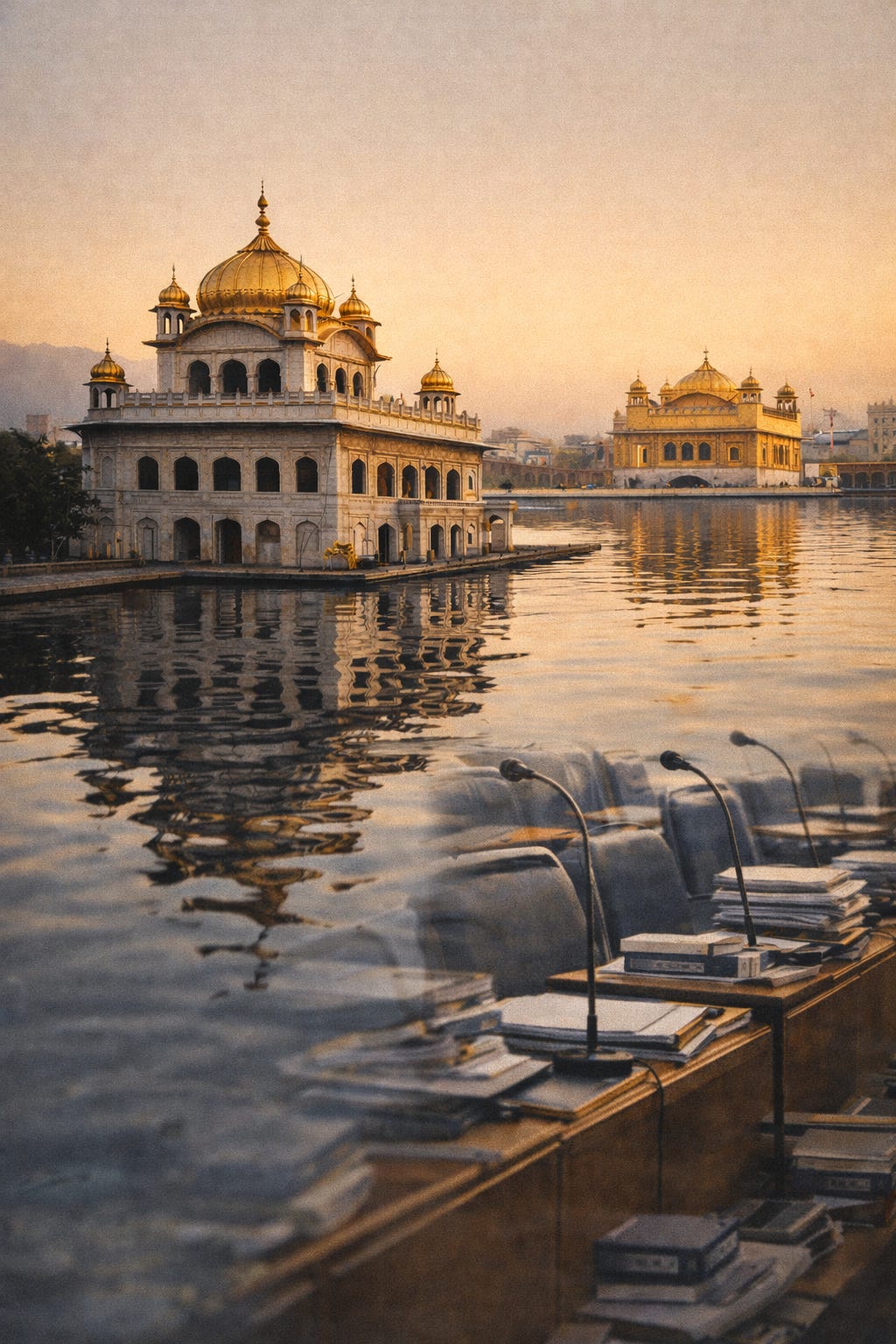
Many Sikhs in the diaspora have come to feel that no real future direction for the Panth can now come from Punjab. This essay argues that the real problem is not the Akal Takht itself, but the repeated failure to protect Panthic institutions from capture — and that the answer is not abandonment, but Guru-centred renewal.
By the time the first cup of tea was poured after Sunday divan, a PDF from Punjab was already moving from phone to phone in the foyer. One person said he had only seen screenshots. Another admitted he had not read the full text. Then someone said quietly, more tired than angry, “Let us be honest now. Nothing useful is going to come from there. Every country will have to work out its own Sikhi.”
A few heads nodded.
That sentence has become common in the diaspora. Many Sikhs have reached a hard conclusion: that no real future direction for the Panth can now come from Punjab, and certainly not from institutions in and around Amritsar.
That feeling did not arise from nowhere. It has come from real disappointment — from visible pressure, weak leadership, repeated injury to Sikh trust, and the erosion of confidence in Panthic institutions.
So the frustration is understandable.
But I believe the conclusion is wrong.
The Akal Takht, in its true meaning, is not the problem. The deeper problem is that the Panth has repeatedly failed to protect the Akal Takht and related institutions from capture. We then look at the captured machinery, mistake it for the principle itself, and begin to think the answer is to walk away.
That would be a serious mistake.
What I mean by “capture”
When I say capture, I do not mean a dramatic takeover in the film sense. I mean something quieter and more dangerous.
An institution is being captured when the people who control money, buildings, jobs, appointments, access, publicity, or administrative machinery are able to shape outcomes in matters that should be decided by Gurmat. If you can hire, fire, isolate, platform, delay, reward, or publicly frame a person or office, you already have leverage. You may never say, “We are controlling Panthic authority.” But you may still be doing exactly that.
That is capture.
It begins long before any public scandal. It begins when the design quietly allows the same people to control both ordinary administration and matters that carry Panthic weight.
This is why one distinction matters so much: trusteeship is not sovereignty.
By trusteeship, I mean the necessary human work of running institutions: property, accounts, staffing, contracts, kitchens, schools, transport, buildings, insurance, legal compliance, and routine management. None of that is unimportant. A gurdwara cannot run on slogans. Someone has to keep the doors open, the kitchens supplied, the accounts clean, and the staff paid.
But that is not the same thing as carrying authority over Sikh fundamentals.
Running the building is not the same thing as carrying the Panth.
Gurbani gives the spirit of honest stewardship very plainly:
ਘਾਲਿ ਖਾਇ ਕਿਛੁ ਹਥਹੁ ਦੇਇ ॥
ਨਾਨਕ ਰਾਹੁ ਪਛਾਣਹਿ ਸੇਇ ॥੧॥
ghaal khaae kichh hathahu de-e.
naanak raahu pachhaaneh se-e. ||1||
Plain sense: Those who earn honestly and share by their own hand are the ones who recognise the path.
Ang 1245
That is the spirit trusteeship should have: honest labour, clean handling, sharing, service. But honest stewardship is still stewardship. It is not spiritual sovereignty.
By sovereignty here, I do not mean a modern nation-state. I mean the Panth’s authority in matters like Sikh fundamentals, baseline discipline, and claims that ask obedience beyond ordinary administration. Once trusteeship and sovereignty are blurred, every administrative dispute can turn into a Panthic legitimacy war.
Why the Akal Takht should not be confused with the machinery around it
The Akal Takht was never meant to be a committee office, a payroll position, or a stage for political management. It stands for the Panth carrying temporal responsibility under the Guru.
That is why I do not say the Akal Takht has failed the Panth.
I say the Panth has repeatedly failed to protect the Akal Takht.
We say the Takht matters. We say it is central. We say it carries Panthic dignity. But do we actually build protections around it? Do we stop payroll leverage? Do we stop committee control from becoming doctrinal pressure? Do we stop party and state interests from crowding out Gurmat? Do we insist on visible process, recorded reasons, and review?
Too often, no.
So the failure is not in the idea of the Takht. The failure is in the governance around it.
This matters because Sikhi does not allow any office to become self-justifying. The centre remains the Guru, not the human arrangement around the Guru.
ਸਬਦੁ ਗੁਰੂ ਸੁਰਤਿ ਧੁਨਿ ਚੇਲਾ ॥
sabad guroo surat dhun chaylaa.
Plain sense: The Shabad is the Guru; attuned consciousness is the disciple.
Ang 943
And again:
ਬਾਣੀ ਗੁਰੂ ਗੁਰੂ ਹੈ ਬਾਣੀ ਵਿਚਿ ਬਾਣੀ ਅੰਮ੍ਰਿਤੁ ਸਾਰੇ ॥
baaNee guroo guroo hai baaNee vich baaNee amrit saaray.
Plain sense: Bani is Guru, and Guru is Bani; within Bani is the life-giving essence.
Ang 982
Once that is clear, one thing follows immediately: no committee, office, title, or platform can place itself above review in the light of the Guru.
Renewal is not betrayal. It is part of Sikh history.
Some people speak as if Sikh governance must remain in exactly the form it took in the twentieth century. Sikh history does not teach that.
What must remain constant is piri: the Guru at the centre, Shabad as supreme, no office above the Guru, and no human system equal to Gurmat.
But miri — the way the Panth carries public and temporal responsibility — has changed in form over time.
In simple language, piri means Sikh life remains under the Guru. Miri means Sikhi does not stop at private devotion. The Panth also carries public responsibilities in the world: institutions, discipline, justice, welfare, defence of dignity, and truthful collective life.
The point of miri-piri is not that politics becomes holy. The point is that temporal power must remain answerable to spiritual truth.
Japji Sahib gives the test with complete force:
ਸਚਹੁ ਓਰੈ ਸਭੁ ਕੋ ਉਪਰਿ ਸਚੁ ਆਚਾਰੁ ॥
sachahu orai sabh ko upar sach aachaar.
Plain sense: Truth is high, but higher still is truthful living.
Ang 62
That is why “constitutional” thinking is not foreign to Sikhi. All I mean by it is the discipline of keeping human power in its place: what belongs to the Guru, what belongs to administration, who may claim what, and how those claims are checked. That is not a Western import. It is simply the refusal to let office pretend to be Guru.
Sikh history should have taught us this already. When Sikh centres were captured, Sikhs did not conclude that those centres no longer mattered. They struggled, organised, and sacrificed to free them. The gurdwara reform movement itself was born from that conviction. Sikhs did not suffer arrest, beating, and death because they thought sacred institutions were irrelevant. They did so because those institutions mattered enough to recover.
But history also teaches a second lesson. Once property and administration were reorganised, bodies needed for management came to sit too close to claims of Panthic authority. The first capture was visible. The later confusion was more constitutional: management began to sound like mandate.
That is how the same problem returned in a different form.
So there is no reason in principle why Sikh governance cannot change again now. If present structures are failing to protect the Guru’s house from capture, then honest renewal becomes a duty, not a betrayal.
Punjab still matters. Punjab alone is not enough.
Some people, seeing all this, say: fine, then let us stop looking to Amritsar.
I understand the temptation. But I think that is another mistake.
Our ultimate centre is the Guru, not geography by itself. Sikhs do not have a pilgrimage logic in which one place replaces the Guru. Shabad remains supreme.
But that does not mean place no longer matters.
The Panth lives in history, memory, institutions, and Sangat. Amritsar carries all of that. Punjab still holds a vast part of Sikh daily life. Darbar Sahib, the Takhts, village gurdwaras, schools, family practice, and the ordinary rhythm of Sikh existence still matter to Sikhs everywhere.
So I do not believe Sikhs across the world will ever simply stop looking toward Amritsar. They may be disappointed. They may be critical. They may distrust particular decisions. But they will still look there in some way.
That is why abandonment is not serious.
But the opposite mistake is also dangerous. Punjab alone cannot honestly carry the whole Panth now. If a claim is being made on Sikhs across the world, that claim cannot truthfully rest on one territory alone, one committee alone, one statute alone, or one local process alone.
A global Panth requires global legitimacy.
That means the wider the claim, the heavier the burden. If someone wants to say, “This binds Sikhs generally,” then ordinary questions must be answerable: Who took part? On whose behalf? From where? With what reasoning? Was dissent recorded? Is this guidance or binding? What review exists?
Those are not hostile questions. They are how truth protects itself.
So we must hold two truths together at once:
Punjab still matters deeply.
But Punjab alone is not enough.
Amritsar remains central.
But Amritsar cannot honestly act as the whole Panth.
That is not a contradiction. It is the reality of a global Sikh people.
What happens if every region just develops its own Sikhi
At this point, some will say: then let every region manage its own future.
Australia its own way.
Britain its own way.
North America its own way.
Southeast Asia its own way.
At first that sounds practical. But over time it would be dangerous.
This drift would not happen in one dramatic break. It would happen quietly, in ordinary places. In one country, donor pressure would start shaping what can and cannot be said from the stage. In another, committee habits would begin deciding questions that should have been tested by Gurmat. In another, children would inherit visible Sikh identity but little direct access to Gurbani. In another, institutions would become efficient but spiritually thin. The differences would show up in classrooms, in committee rooms, in what gets taught as “normal Sikh practice,” and in what counts as final when a dispute arises.
A little variation is natural. That is not the problem.
The problem is what happens when local variation continues without a shared Guru-centred discipline, without any common test for Panth-wide claims, without a route of review, and without a living connection to one another.
Then what begins as adaptation becomes fragmentation.
Over a century or two, these places would no longer be local variations of one Panth. They would become several Sikhities sharing a name but not a common constitutional life.
And if one region is then captured in its own way, what is the route back?
That is why the answer cannot be regional isolation.
What renewal actually looks like
Keep the Guru above every office. No office can become a substitute Guru. Titles, robes, committees, boards, and inherited prestige are all human things. They may serve. They may advise. They may administer. But they must never place themselves above the Guru or beyond review in the light of Gurmat.
Keep trusteeship in its own lane. Trusteeship should be strong, competent, and honourable. Sikh institutions need clean administration. Accounts must be transparent. Property must be protected. Staff must be treated fairly. Kitchens, schools, and services must run well. But trusteeship must remain trusteeship. It must not quietly become the source of Panthic authority because it happens to control land, money, access, or paperwork.
Protect sovereignty functions from payroll and committee leverage. Anything that carries Panthic sovereignty — doctrine, identity boundaries, baseline discipline, Panth-wide binding claims, Takht functions — must be protected from being bent by salaries, housing, staffing, premises, publicity, donor pressure, or committee votes. If a person or office can be pressured through those levers, then sovereignty has already begun to be captured.
Let decisions rise only as far as they need to rise. Not every issue is a Panth-wide issue. A local matter should stay local unless Sikh fundamentals are truly engaged. Regional matters should be handled regionally. Only matters that genuinely affect Sikh fundamentals, baseline discipline, or Panth-wide legitimacy should move upward. In plain terms, the Panth must first ask what kind of question it is dealing with: local administration, regional coordination, wider guidance, or something that truly asks obedience from Sikhs across jurisdictions. This one discipline alone would calm a huge amount of unnecessary crisis.
The wider the claim, the wider the participation. If a decision is being presented as affecting Sikhs across countries and jurisdictions, then the process must reflect that reality. A global Panth cannot be bound honestly by a territorially narrow process pretending to speak for all. Wider claims need wider representation, clearer reasons, better publication, and visible routes of appeal or review.
Keep the Guru’s house open, while keeping binding roles accountable. This is where “two circles, one dignity” matters. One circle is the open life of the Guru’s house: darbar, langar, seva, learning, and Sangat. The other is the more exacting circle of roles that claim to bind Khalsa discipline or Panth-wide obligations. Different responsibilities, but one dignity. This distinction is about accountability, not spiritual rank.
Gurbani gives the dignity test clearly:
ਅਵਲਿ ਅਲਹ ਨੂਰੁ ਉਪਾਇਆ ਕੁਦਰਤਿ ਕੇ ਸਭ ਬੰਦੇ ॥
ਏਕ ਨੂਰ ਤੇ ਸਭੁ ਜਗੁ ਉਪਜਿਆ ਕਉਨ ਭਲੇ ਕੋ ਮੰਦੇ ॥੧॥
aval alah noor upaaiaa kudrat kay sabh banday.
ayk noor tay sabh jag upjiaa ka-un bhalay ko manday. ||1||
Plain sense: The One first created the Light; from that one Light the whole world arose — so who is high and who is low?
Ang 1349
That is why no governance arrangement that relies on humiliation, exclusion, langar denial, contempt, or spiritual theatre can be called Gurmat.
Make review normal. A serious Panth cannot survive if every disagreement becomes faction war and every criticism is treated as betrayal. Review, appeal, correction, and published reasons are not weakness. They are how trust survives. A body that cannot explain itself, record its reasoning, or face review is usually relying on prestige or pressure rather than truth.
This is not anti-Punjab. It is not anti-institution. It is not anti-Akal Takht.
To say that the present structure is producing capture is not anti-Punjab. It is anti-capture.
To say that trusteeship is not sovereignty is not anti-institution. It is pro-clarity.
To say that global Sikhs must be part of Panth-wide legitimacy is not anti-Amritsar. It is pro-truth.
To say that Akal Takht functions must be protected from committee leverage is not anti-Akal Takht. It is pro-Akal Takht.
The real anti-Panth habit is the opposite one: using sacred language to hide administrative control, using titles to replace process, using historical prestige to silence questions, and using disappointment as an excuse to abandon what should instead be renewed.
That is not realism. It is a quiet form of resignation.
What one Sikh can do this week
It is easy to read an article like this and think: fine, but what can I do?
Start smaller than that.
The next time a Sikh statement or controversy appears, do not begin with the loudest reaction. Start with four questions:
What is being claimed here — administration, guidance, or something binding?
Who decided it, and who was represented?
What Gurbani-anchored reasoning has been shown?
What review, correction, or appeal exists?
And when you hear someone say, “There is no point looking to Amritsar anymore,” ask one more question quietly:
Are we rejecting the Takht itself — or only the captured machinery around it?
That question matters.
Because if we do not learn to distinguish principle from capture, we will abandon the wrong thing.
And if we do not learn to distinguish trusteeship from sovereignty, we will keep replaying the same crisis in new costumes for another generation.
So start this week with one simple sentence in your own home, your own sangat, or your own committee conversation:
Is this a matter of service — or a matter of sovereignty?
If enough Sikhs learn to ask that calmly, the renewal will already have begun.
Bhul chuk maaf.
— PanthSeva
Verification — so you do not have to trust me
You can verify the Gurbani references used above directly in Sri Guru Granth Sahib Ji:
ਘਾਲਿ ਖਾਇ ਕਿਛੁ ਹਥਹੁ ਦੇਇ ॥ ਨਾਨਕ ਰਾਹੁ ਪਛਾਣਹਿ ਸੇਇ ॥੧॥ — Ang 1245
ਸਬਦੁ ਗੁਰੂ ਸੁਰਤਿ ਧੁਨਿ ਚੇਲਾ ॥ — Ang 943
ਬਾਣੀ ਗੁਰੂ ਗੁਰੂ ਹੈ ਬਾਣੀ ਵਿਚਿ ਬਾਣੀ ਅੰਮ੍ਰਿਤੁ ਸਾਰੇ ॥ — Ang 982
ਸਚਹੁ ਓਰੈ ਸਭੁ ਕੋ ਉਪਰਿ ਸਚੁ ਆਚਾਰੁ ॥ — Ang 62
ਅਵਲਿ ਅਲਹ ਨੂਰੁ ਉਪਾਇਆ ਕੁਦਰਤਿ ਕੇ ਸਭ ਬੰਦੇ ॥ ਏਕ ਨੂਰ ਤੇ ਸਭੁ ਜਗੁ ਉਪਜਿਆ ਕਉਨ ਭਲੇ ਕੋ ਮੰਦੇ ॥੧॥ — Ang 1349
If PanthSeva is trying to do anything, it is this: to bring Sikh learning and Sikh governance back under the living authority of Shabad-Guru. Subscribe for future essays in this series.