


I was recently asked to find a copy of Qaida-e-Noor, a primer said to have been prepared under Maharaja Ranjit Singh. The request came with a claim that the Maharaja decided in 1809 to educate people of every religious community and build their character. It also alleged that Gottlieb Wilhelm Leitner, who became Principal of Government College, Lahore, in 1864, destroyed the primer, although a copy must survive somewhere in Britain. [9]
These claims matter because they are being presented as educational history, not simply as admiration for a ruler. They describe an organised programme and attribute its destruction to a named person.
There is evidence of teaching and reported support for teachers under the Lahore kingdom. The evidence examined so far has not established the Qaida-e-Noor programme or supported the allegation that Leitner destroyed its primer.
The Roman line is only a reading aid, not the translation. The English sentence gives the plain meaning.
Guru Nanak Sahib Ji says:
ਵਿਦਿਆ ਵੀਚਾਰੀ ਤਾਂ ਪਰਉਪਕਾਰੀ ॥
Vidiaa veechaaree taan par-upkaaree.
Learning has truly been reflected upon when a person becomes of benefit to others.
Aasaa, Mahalla 1, Guru Nanak Sahib Ji, Chaupade, Shabad ending ॥੪॥੨੫॥, Panna 356. One-line continuous excerpt from the first stanza. [1]
Professor Sahib Singh Ji explains the line as a test of whether learning has genuinely been considered. The surrounding Shabad tests religious accomplishments in a similar way. The pilgrim’s outward practice is examined alongside mastery of the passions, while the Rahao, the central refrain, turns attention towards the mind’s attachment to the Divine. Learning belongs within that deeper concern with how a person lives before the One. [1]
That concern gives us a reason to ask what education did for people. In this inquiry, we need to establish what was taught, how teaching was supported and whom it reached. A worthy stated purpose cannot establish that a government adopted or fulfilled it. That requires historical evidence.
Teachers, books and the work of learning
The Lahore kingdom inherited several forms of education. Pandits taught Sanskrit and other subjects; Muslim establishments provided religious and linguistic instruction; munshis taught writing and skills used in clerical and government work. Commercial instruction addressed calculations and accounts. Learning also took place within households and Sikh congregational life. These arrangements differed in their purposes, resources and accessibility. [2, 4]
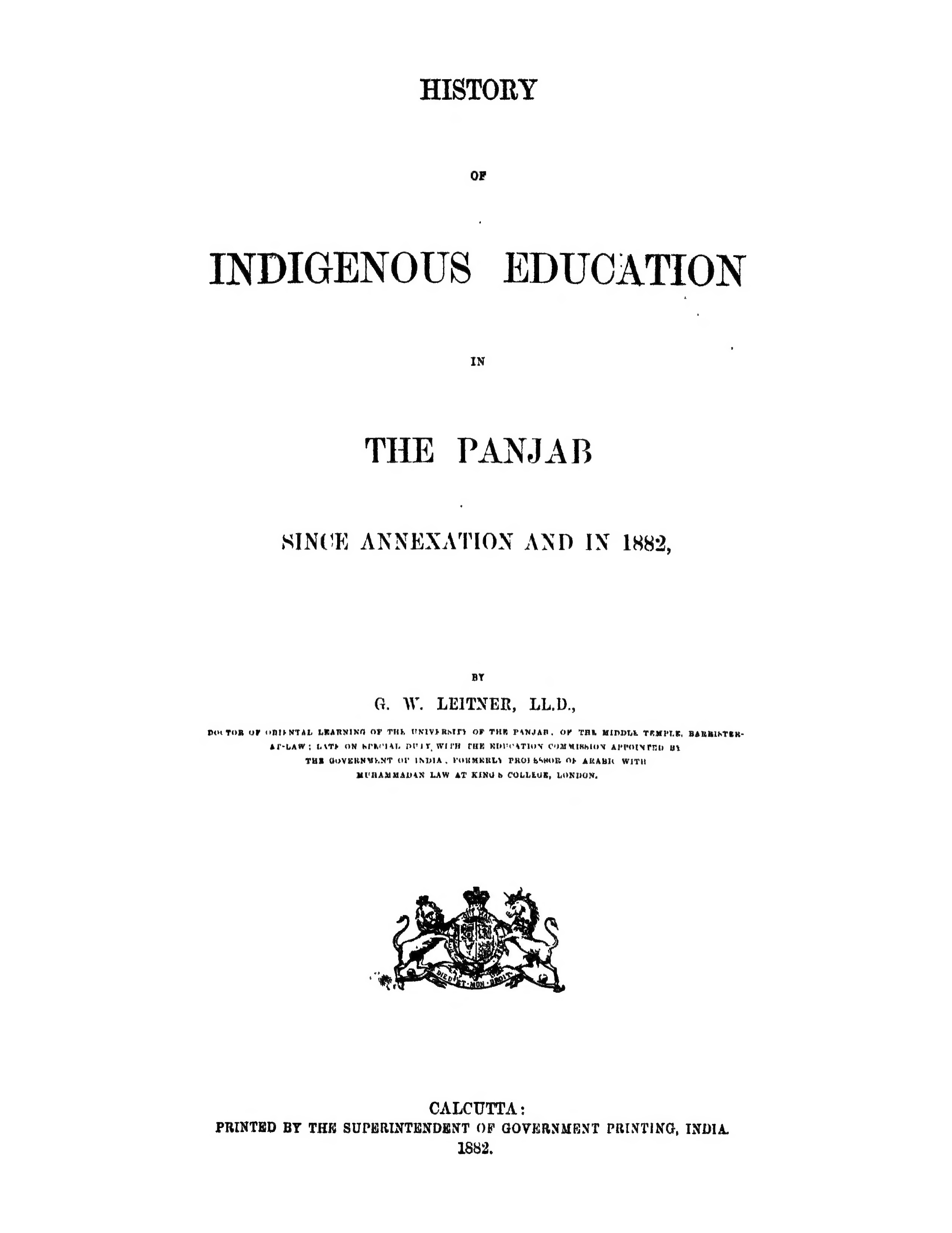
Title page of G. W. Leitner’s History of Indigenous Education in the Panjab since Annexation and in 1882 (Calcutta, 1882). This is Leitner’s report, not the Qaida-e-Noor primer. Source: Internet Archive. [2]
Leitner’s History of Indigenous Education in the Panjab since Annexation and in 1882 provides a useful description of elementary Gurmukhi instruction. Children began by forming letters on prepared ground, where mistakes could be erased. Some pupils also learned sayings arranged around the alphabet. They progressed to a wooden writing board, or patti. Instruction included numerals, weights, measures and familiar names. [2]
Published in 1882, more than thirty years after annexation in 1849, Leitner’s report combines descriptions from British rule with retrospective accounts. Its teaching sequence cannot automatically be assigned to Maharaja Ranjit Singh’s reign. The Maharaja died in 1839; political conflict and two Anglo-Sikh wars followed. The evidence assembled here cannot separately measure that decade’s educational effects. The Panjab Administration Report for 1849–1851, reproduced by Leitner, describes indigenous provision still operating. [2]
In his opening Introduction, Leitner called 330,000 earlier pupils his “lowest computation”, comparing this with a little over 190,000 in his own day. These are his estimates of pupils, rather than a population literacy census. They describe a substantial educational world, with teaching sustained beyond the court. [2]
Other sections of Leitner’s report discuss Persian literary and moral works, Sanskrit texts and grammar, and the arithmetic required for commercial activity. [2]
For the later nineteenth century, the report also records women teaching the Qur’an to girls and boys. Leitner names Bhani, mother of Ganda Singh, as teaching Gurmukhi to forty girls in their homes at Fattahabad. Mrs Mary Chatterji recommends paid pupil-teachers as a way to prepare older girls to teach. Miss W. N. Greenfield, quoted separately, describes children progressing more readily in Gurmukhi because they recognised the language. She explains how parents could encourage reading at home and how pupils could acquire the means to continue learning independently. [2]
Support for teachers and new proposals
Leitner’s account of Saydwala connects reported royal support with identifiable teaching. A later private survey response describes three Pandits teaching Sanskrit works to twelve pupils. It reports that under Maharaja Ranjit Singh the teachers had enjoyed two wells rent-free and an annual cash payment of 100 rupees. They reportedly had no income at the time of the later inquiry. [2]
The twelve pupils belong to that later inquiry, not automatically to the Maharaja’s reign. The account does not identify when or why the earlier support ended.
Cash and rent-free resources could sustain teachers without the ruler managing every lesson. Confirming an existing grant is different from founding an institution, however, and support for maintenance, worship or langar, the shared meal, should not all be counted as educational spending.
A separate episode concerns Fakir Nur-ud-Din, to whom modern accounts attribute Qaida-e-Noor. The American missionary John C. Lowrie reached Lahore in February 1835. In his published account, Lowrie says that the Maharaja had invited him to spend six months of each year there educating sons of Sikh chiefs. He declined that proposal on medical advice, although he accepted the invitation to visit. [3]
During the visit, Fakir Nur-ud-Din asked how Lowrie would teach English while knowing little of the local language and how pupils wanting different subjects would be taught. He also asked who should choose the subjects if the government established a school. Lowrie answered that the government should decide, while a prospective teacher could accept or decline its plan. Lowrie later recorded that two sons of one chief minister came wishing to study English under his direction during his stay. [3]
This is evidence of a particular educational proposal at court. Its intended pupils were sons of chiefs; it does not establish a village programme open to the wider population. Interest in English instruction and authorship of a multilingual primer remain separate historical claims.
What the Qaida-e-Noor accounts actually claim
The published trail includes earlier related accounts. Majid Sheikh’s 2006 column described an 1832 Punjabi Qaida scheme and gave a female-literacy figure without identifying the Company document behind it. His 2010 column alleged the burning of Punjabi primers after 1857. These are earlier related claims, rather than authentication of the full named Qaida-e-Noor programme. [8]
In her 2017 study, Refocusing on the Education System under the Sikh Rule, Robina Shoeb identifies the Fakir Khana family as the principal source of the primer account and says that Leitner also reported it. The family traces its descent from Fakir Nur-ud-Din and maintains a private museum in Lahore. Her Qaida section supplies no footnote identifying a manuscript or the relevant Leitner passage. [4]
Her account names the Gurmukhi and Shahmukhi scripts, Urdu and Persian, and elementary arithmetic among the primer’s contents. It describes about 5,000 booklets distributed to village headmen. Each headman was to learn the material within three months, pass copies to others and write to the Maharaja. [4]
Aashish Kochhar’s 2020 article, Maharaja Ranjit Singh: Pioneering Educator, repeats the teaching chain and attributes it to Leitner. Bhupinder ‘Bo’ Singh’s 2026 SikhNet article, When Literacy becomes Perceived Threat, gives literacy figures of 87 per cent around Lahore and 78 per cent in neighbouring areas. It places the introduction of the initiative in 1832 and a wider campaign in 1837. Those claims need to be distinguished from the alleged 1809 decision in the request sent to me; the different dates do not, by themselves, establish a contradiction. [5, 6]
Qaida refers to a primer and noor to light. The question is whether the particular book and programme can be established.
The headmen’s alleged three-month preparation would be a significant method of turning learners into instructors, without a separate training college. A surviving primer could establish the book’s existence; a distribution order, a headman’s letter or an account of copying costs could help establish the programme. The accounts examined have supplied neither an identifiable original primer nor a precise contemporary passage establishing its operation. Family information remains a lead, while the attribution to Leitner requires the relevant passage.
The percentages require a different kind of evidence. We need to know who was counted, what area was covered, what counted as literacy and how the calculation was made. A number of schools or pupils cannot establish the proportion of an entire population able to read and write.
Neither a contemporary distribution record nor an original calculation for those percentages has been located in this investigation. These gaps do not prove the primer never existed. They prevent us from presenting the programme as an established achievement.
Anu Bharat’s article about Dave Sidhu’s documentary appeared in NRI Affairs on 2 September 2021. It repeats the 87 and 78 per cent figures and says the Qaida “disappeared and was never seen again” under British rule. That is the promotional article’s assertion, rather than evidence of an exhaustive search. The Internet Archive item linked by SikhNet reproduces this piece; it is not an original copy of the historical primer. [6, 7]
The allegation against Leitner
Leitner’s 1882 report criticises the treatment of indigenous education under British administration. It reproduces an official passage describing departmental village schools being required to leave religious premises and discontinue religious books. Those decisions show direct intervention in where teaching took place and what could be taught. The passage does not name Qaida-e-Noor or establish that Leitner personally destroyed it. [2]
The earlier account does not establish that Leitner was responsible for the alleged burning. His appointment in Lahore in 1864 is a separate documented fact. Withdrawing a book from a school, physically destroying it and ordering its destruction are different actions; any specific allegation still requires evidence. [8, 9]
What should now be taught and recorded
There is evidence of teaching, reported material support and educational proposals under the Lahore kingdom. The village-literacy programme attributed to Qaida-e-Noor remains unverified: no authenticated 1809 order or contemporary distribution record has been located in this investigation. We have found no evidence that Leitner destroyed the primer, and no authenticated British holding has been identified. A library possessing Leitner’s report does not thereby possess Qaida-e-Noor. These limits do not erase the teachers or the support that can be identified.
Writers, teachers and institutions presenting this history should distinguish those findings clearly. The primer programme should be identified as unverified until evidence establishes its operation. The allegation against Leitner should not be repeated as fact.
There is also useful work to begin without waiting for Qaida-e-Noor. Archives, libraries and educational institutions can identify surviving teaching materials, record their dates, origins and known ownership, and make suitable images available. Captions should explain what each object is and the evidence connecting it to teaching.
Sources
[1] Shabad Guru Granth Sahib Ji, Aasaa, Mahalla 1, Guru Nanak Sahib Ji, Chaupade, Shabad ending ॥੪॥੨੫॥, Panna 356. SriGranth, complete Panna; Professor Sahib Singh Ji, Sri Guru Granth Darpan, Panna 356. The plain-English rendering follows Professor Sahib Singh Ji’s explanation of the opening line.
[2] G. W. Leitner, History of Indigenous Education in the Panjab since Annexation and in 1882 (Calcutta, 1882): opening page of the Introduction, pupil estimates; Part I, printed pp. 33–34, Gurmukhi instruction; pp. 108–110, women teaching, pupil-teacher preparation and learning through the mother tongue; and p. 156, paragraphs 375–378 of the reproduced Panjab Administration Report for 1849–1851; Part II, printed p. 91, Saydwala return; Appendix VI, printed p. 20, paragraphs 17–19, school premises and books. Digitised 1882 edition.
[3] John C. Lowrie, Two Years in Upper India (New York: Robert Carter and Brothers, 1850), printed pp. 143–144, invitation and medical refusal; pp. 164–165, discussion with Fakir Nur-ud-Din; p. 169, two sons of one chief minister wishing to study English. This is the published account of the 1835 visit. See also Yaqoob Khan Bangash, “The Maharaja’s American visitor”, The News on Sunday, 6 July 2014; and “Missionaries, Christianity, and Education in 19th Century Punjab”, FWU Journal of Social Sciences, vol. 12, no. 1, Summer 2018, pp. 156–163. Lowrie’s page references here follow the inspected 1850 edition.
[4] Robina Shoeb, “Refocusing on the Education System under the Sikh Rule”, Journal of the Punjab University Historical Society, vol. 30, no. 2, July–December 2017, pp. 159–166; especially “Quaida Noor”, p. 164. For family context, see the museum’s “Fakir Family” account, 11 December 2007, and its museum introduction.
[5] Aashish Kochhar, “Maharaja Ranjit Singh: Pioneering Educator”, Live History India, 22 November 2020; especially “Qaida Noor: A Novel Method”.
[6] Bhupinder ‘Bo’ Singh, “When Literacy becomes Perceived Threat”, SikhNet, 8 January 2026; especially “Maharaja Ranjit Singh’s Education System”. Sources [4]–[6] identify the published claims being examined; they are not treated as independent authentication of the alleged programme.
[7] Anu Bharat, “Qaida-E-Noor: Dave Sidhu’s film explores Maharaja Ranjit Singh’s ‘Qaida method’ of learning”, NRI Affairs, 2 September 2021. Reproduced in the Internet Archive item titled Qaida E Noor, uploaded 8 May 2023. A modern piece about the documentary, not a surviving historical primer.
[8] Majid Sheikh, “The maharajah and education”, identified in the APNA reproduction as Dawn, 12 August 2006; and “Destruction of schools as Leitner saw them”, Dawn, 31 October 2010. These are earlier related published claims; the 2006 article was consulted through the APNA reproduction.
[9] British Library, Photo 1000/43(4431), catalogue record, “Scope & Content”: Leitner’s life dates and appointment as Principal of Government College, Lahore, in 1864.
Errors will be corrected publicly with a dated note.
Strong disagreement is welcome. Contempt is not.
Bhul chuk maaf karni Ji.
Gurjit Singh Sandhu
PanthSeva
London